Amman Baccalaureate School – Model United Nations Opening Ceremony
I want to live in a world where every human being has opportunities, and every human being has a chance to have water. Water! It’s a fundamental basic right.
Good morning, and thank you, Your Royal Highness [Princess Sumaya bint Al-Hussein], so much for your leadership, for convening and championing this group. I want to honor you very specifically, Your Highness, because in a world where diplomacy and multilateralism are increasingly being lost, your investment in youth and in the future generation is something that will benefit us all. Thank you so much for everything that you do.
I would also like to thank the administration, the school leaders, and the parents. Our future truly relies on your children. Thank you very much for the investments you make to prepare them for the future.
And most of all, thank you to all of the delegates here: those of you who traveled from afar, for many days and many hours, coming from India, Pakistan, Lebanon or from across the river [from Palestine]. We know that the journey, although not far in distance, can be lengthy, and we thank you for making that effort. And to those from Jordan, from across the Kingdom, it is equally an honor to have you here.
Honoring a Legacy of Dialogue and Peace
Before I get into my main comments, I want to underscore and echo what Her Royal Highness said about the late King Hussein. For me, he continues to live on in this nation through his powerful legacy – a legacy also carried by His Majesty King Abdullah: one that promotes dialogue over conflict, peace over war. This is something we urgently need in the world today.
I have been in the UN for almost 20 years. And the world in which the UN existed 20 years ago was in a better place than the world I see today. Today’s world is fractured. I wish I could tell you, as young delegates, that you are entering adulthood in a better world—unfortunately, that is not the case.We see an acceleration of fragmentation, a return to the arms race, and a return to hard power over soft power and influence.
Over the next few days, you will have the chance to learn the issues deeply and the skills needed to change this world. So let me encourage you, as you go through the next few days, to really do this with intention, because these are not just school activities nor extracurriculars. The efforts you will make over the next days will benefit you regardless of what career path you take. The world is headed in dire direction, and we need you to come into the prime of your lives ready to lead. This requires real skill.
The Power of Deliberation
I want to recognize the Amman Baccalaureate School for everything you are doing, as well as the Secretariat and everyone involved. The theme of “deliberate to liberate” theme resonates deeply with me—the idea of listening deeply, understanding those who sit across the table, understanding perspectives that are not your own, and asking the hard questions that go beyond superficial – asking why people believe certain things, asking the hard questions.
As Her Royal Highness said: behind every opinion there is fear, loss, or personal experience.
Asking those questions, seeking real understanding, and then finding a way to compromise, to come together, and to create mutually beneficial societies is exactly what we need. And frankly, it is what I see slipping away when I look at world politics today.
This begins with the willingness to come to the table and understand each other.
Lessons From 20 Years in the UN
As I have been in the UN for 20 years, let me share a few stories. As mentioned, I’ve held many roles in many places. I started my career in the Middle East, in Gaza. I [then] went to Iraq, then back to Gaza, back to Iraq, then New York, then Jerusalem, then Iraq again. I spent time in Indonesia, South Sudan, Kenya, Chad, and Peru in South America. When I was in New York, I worked on the Ebola public health crisis in DRC, as well as Afghanistan, Pakistan, Venezuela, Haiti, Ukraine – a whole variety of crises. How many passports? A few, with lots of stamps.
With this honor – and it truly has been an honor and a privilege – you see many things. A number of years ago, the Venezuela humanitarian crisis was coming to a head. Up until 2019, the issue had not been discussed [by the UN Member States], but it needed to be. The issue was brought to the Security Council, and the UN [Under-Secretary-General for Humanitarian Affairs] was asked to provide a briefing. It was my job to draft the brief and engage Member States on the Council in advance of the brief.
It was so sensitive that the Security Council chamber — which rarely has a large audience — was full. On TV you see Ambassadors sitting at the round table, but what you don’t see is the gallery behind them, which is usually not very full. Not every issue draws attention.
But on that day, the observation seats were full and included foreign ministers, amongst others – something extremely rare. The viewpoints between the Permanent Members of the Council were polarized and the context was tense. Part of my job was to create a conducive environment for the briefing – one that would create space to go beyond unilateral and opposing statements and reach to dialogue.
But how do you get major powers to come to the table and listen to each other? This is not easy.
We went out and found allies. Sometimes the major powers are the hardest to bring in, so you look also to others, like those from the Elected 10 Member States of the Security Council. States like Jordan, that value diplomacy and dialogue and have relations with nearly everyone, that can create alliances and promote dialogue over political positioning.
Listening, Even When It’s Hard
These are the skills I want you to learn over the next few days.
Over the next few days, during this Model UN, you will embody your issues. You will identify with your cases. And someone will come to the table and say everything you believe is wrong. You will be triggered. Your emotions will rise. And you will have to be able to take that in, absorb it, understand where that perspective comes from, and find middle ground.
These are not easy issues. I spent a lot of time in Gaza and Jerusalem, where negotiations are extremely tough. The lived experiences of two populations are very different. Bringing those experiences to a middle ground, to consensus, to a path forward, is one of the hardest things I’ve been part of.
Why Your Leadership Is Needed Now
As you go through the next few days, dive into your issues. Deliberate. Listen carefully. Find solutions that benefit all of humanity, that don’t leave women behind, or persons with disabilities behind, or youth behind. That bring everyone forward together.
If we don’t, we will continue to see climate change, war, and defunding. Let me talk about defunding for a moment. The UN and humanitarian action are being defunded. We have more people in need [of assistance in the world] than we’ve had in decades, and less money than ever.
We're in an increasingly dire situation. We need to find ways forward. We need to prevent war – now more than ever – because we have declining funding from States to pay for its consequences. This is the world that we're entering.
We need your energy and creativity to say: “We don’t accept this. This is not the world I want. I don't want to live in this kind of world. I want to live in a world where every human being has opportunities, and every human being has a chance to have water. Water! It’s a fundamental basic right. Where every human being has the opportunity to have health care. Every human being has the opportunity to work if they want to work. And everybody has the right, as Her Royal Highness said, to live without fear and to live in a world of peace.”
Over the next few days, you will learn how to create this world. Model UN is an incredibly important opportunity to see yourselves as a future diplomat, a future changemaker, and a peacemaker, because this is what it's going to take to create the better world that we all want.
A Story From Before the UN: Youth Leading Change
As I move to close, let me share one more example of from my career, from before I joined the UN. More than 20 years ago, I worked at an advocacy-oriented NGO in New York focused on women and children in conflict. Back then, youth-led research at scale simply did not exist. The world you live in now, where youth voices are sought and you have opportunities to speak, is relatively new.
We believed youth voices were important. So we traveled to Kosovo, Sierra Leone, and Northern Uganda. We trained young people to conduct research, collect experiences, and document what mattered to them, giving them the opportunity to control the dialogue about their own experiences and views. They were then brought to New York to present their findings, and for the first time young people – adolescents – sat in the UN Security Council to say: “As a young person, this is what we need.” That had never happened before. And there was real power and influence in bringing these voices to New York.
Today this is more common, but 20 years ago, this was the first time this had ever been done.
The question I would have for you is how do you take the progress that has been made since then [on youth empowerment] further forward? The world has made progress over 20 years, but we're not done yet. We have more to do.
We need to put youth into the conversation more. We need to give you more space. Youth empowerment is a UN goal, but it is not going to be easy to achieve. People who have power usually do not let it go easily. Most will not actually give youth the space that the UN says they should have. So you have to be smarter than the people in the room. You have to be more clever. You have to find your allies and create space for yourself.
Over the next couple of days as you dialogue and debate global issues, I want you to practice this: be smart, clever, find allies, and create space for yourself to find solutions.
Because if we miss this goal, the world will continue down the path we just saw on the screen. And I think we can do better. We must do better.
Throw yourself into this Model UN exercise. Practice the diplomacy with all your heart. Control your emotions when somebody says something that really upsets you. But channel that emotion into finding solutions that work.
The Responsibility You Carry
As delegates and emerging global citizens, you carry a greater responsibility than anyone else in this room.
You are the future – you are my future. You are the future of everyone in this room.
We need your ideas. We need your empathy. And we need your courage.
Because the future of peace and progress is not going to be written by other people, it will be written by you.
As a citizen of the world, again, I thank you for your efforts. I will be retired by the time you get there, so please do a good job. I'm sure you will. We’re counting on you.
I commend you, your parents and teachers, and again, Your Highness, for bringing this together.
Please feel free to ask me any questions; I’m happy to discuss more of my experiences or views.
Have a great time, enjoy this experience, and be truly dedicated and passionate, because these are the skills you will need.
Congratulations to all of you, and good luck.


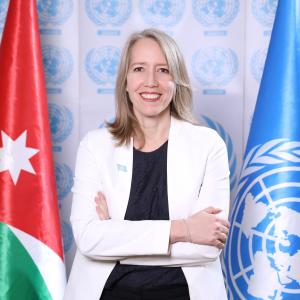
Speech by
Goals we are supporting through this initiative